The Sandy Bottom
Peek into the world hidden beneath the sand—home to unique creatures adapted to life on the seafloor
Start scrolling

360° diving
Dive and discover the magnificent nature of the sandy bottom
what?
Between one coral outcrop and the next—and out in the deep sea too—lies the sandy bottom. It may lack good PR, but it is important and critical to every marine creature. The soft-bottom habitat is the second-largest ecosystem on Earth, and despite its sleepy beige look it is packed with life.
where?
From shallow water to the deep sea
who?
Black sea cucumber, sea pen, long-spined sea urchin, ghost crab, mangrove stingray, polychaete worms, and more
What is it good for?
The sandy habitat plays a central role in the endless cycling of matter in the ecosystem. It is essential to the existence of all marine life—including species that live on reefs, in seagrass, and in the depths.
Who’s coming to the sandbox?
You fin-paddle between the skyscrapers of the coral reefs. You can’t get over the colors, the shapes, the pace—so much life, oh wow. In the passage from one coral head to the next, you glance at the bottom. A sandy expanse stretches below—left and right nothing but sand, a soft, sleepy substrate that left all the action to the reef. Here and there a shell, a faint trail, a field of little mounds. Nothing going on here.
Or so it seems.
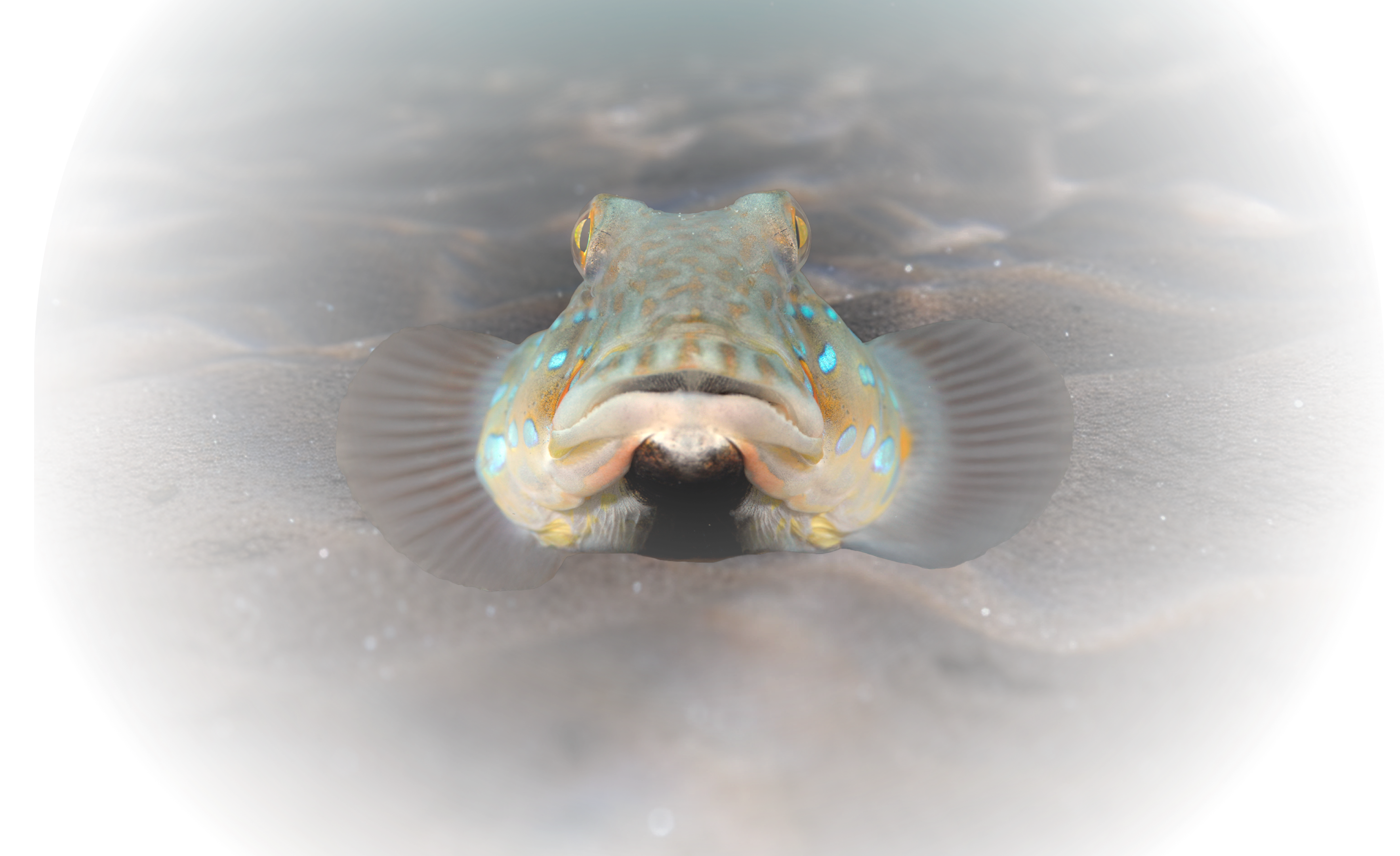
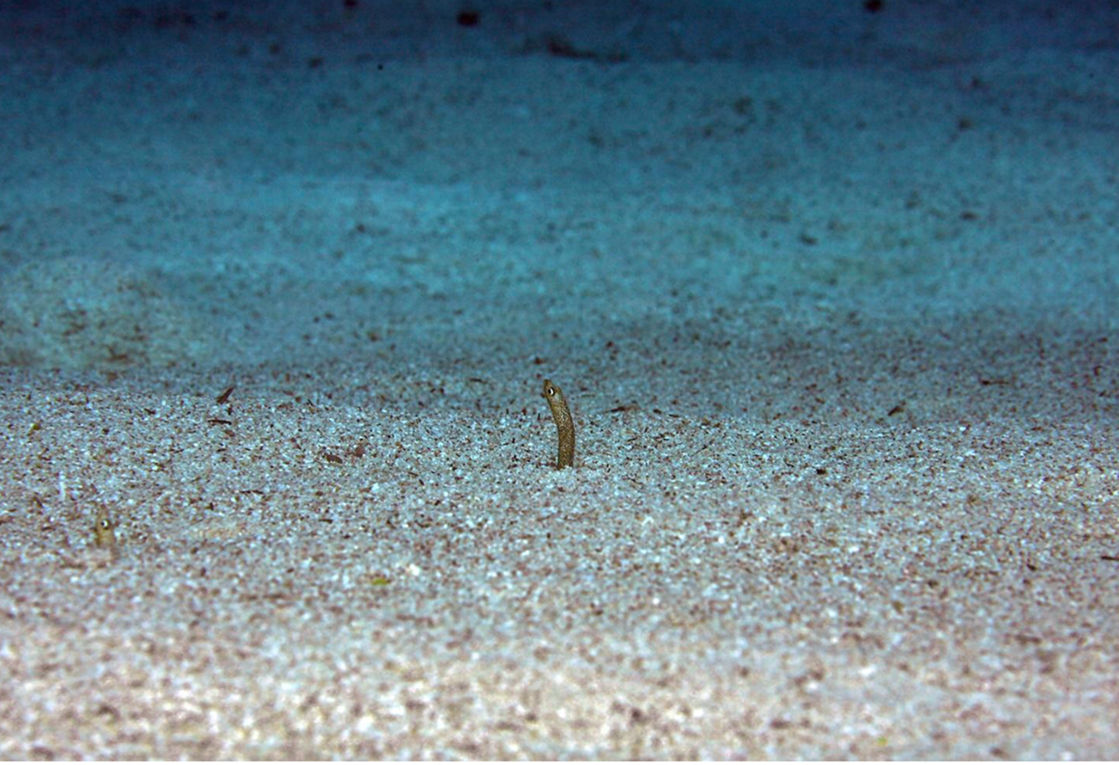
The quiet is deceptive; something is stirring under the surface… Then, in a split second, a sand-diver fish rises from the grit—a sea catfish dusted with sand. The flat disc body with the thin tail lifts off, leaves a puff behind, hovers over the bottom, and “downs” a stray worm. A few meters away a shell wakes up, shifts and rattles; claws and legs poke out, and hop—a hermit crab pops out, its eyes following behind. And that click-click-click in the background—castanets from a round crab you didn’t notice because it matches the sand perfectly. A band of long thin eels suddenly sticks up from the bottom, and that’s nothing compared to night, when everything in the sand comes out of hiding to fix dinner.
Don’t let the sand fool you—the sandy bottom is a tight, crowded ecosystem. Who comes to play in the sandbox? Countless crabs, worms, fish, squid, sea urchins, snails, colorful nudibranchs, and creatures that learned to cope with what sand throws at them.
Welcome to the sandy habitat—the dusty sibling that “doesn’t see eye to eye”—and how could it, with all this sand in the way?
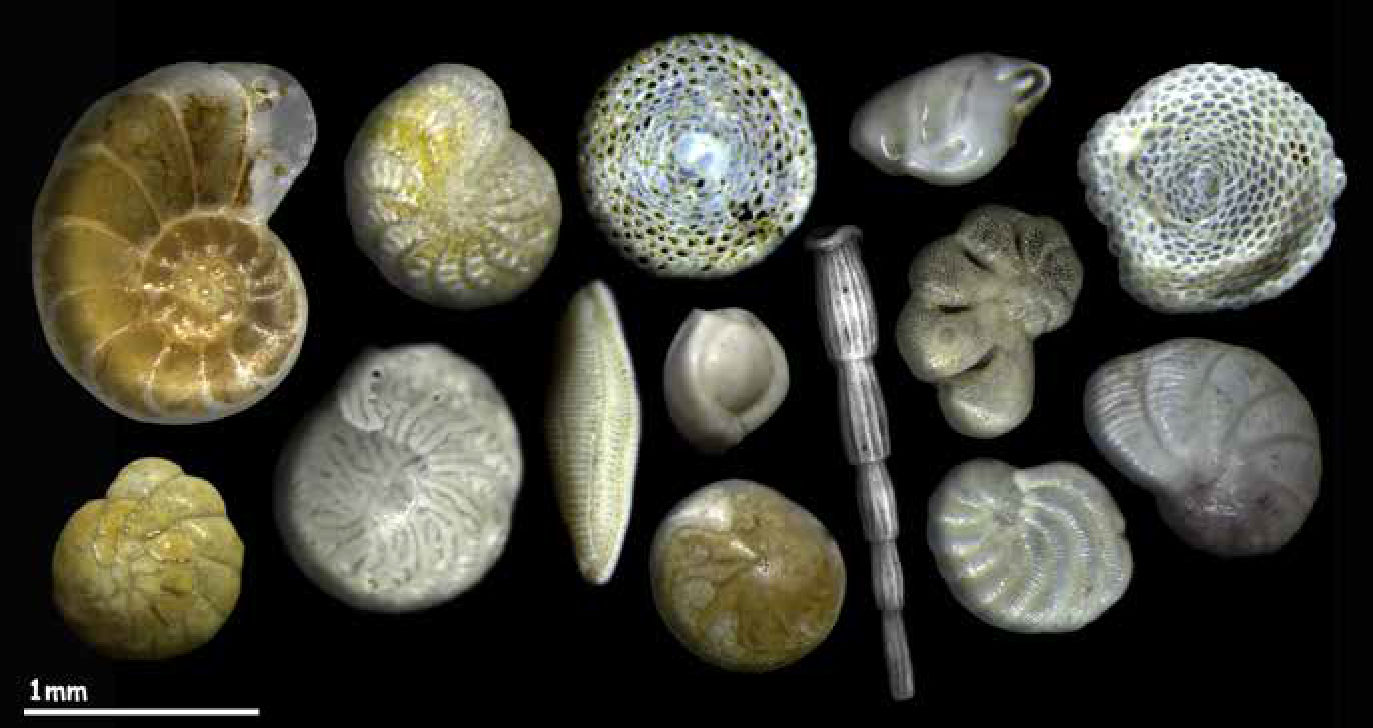
The soft substrate in the Gulf of Eilat is built from coral fragments nibbled by fish, skeletons of reef creatures that once lived there, and a unique mix of grains worn from the desert mountains around the bay. Put sand from the bottom under a microscope and you’ll see it isn’t uniform—it’s a mosaic of shapes and colors.
One building block, for example, is the “foraminifera”—not a pretty name, but the animals? Beautiful. Delicate creatures that, like stony corals, build a chalky skeleton—some even partner with symbiotic algae. When they die, they donate their bodies to the substrate. The sand remembers.
The residents of the marine sandbox aren’t here only to sunbathe on a dune and play backgammon. All the diggers, burrowers, and sand-stirrers do a wonderful ecological service for the seabed: they plow and aerate the system, alongside bacteria and animals that break down, mix, and move organic matter. Sand isn’t just sand—it’s a whole recycling industry that feeds every creature in the sea.

Trust the sand
Truth is, life in the sand isn’t easy. First, you can’t really trust sand—any passing wave, a jumpy current, or a sharp flick of a fin can set off a slide and bury the house you just built. If you’re spineless or in a brittle shell, predators are waiting—stingrays, bottom-prowling fish, needle-toothed eels. Where will you hide? In the grains? Sweetheart, you’re in a wide-open desert; you can’t tuck into seagrass blades or slip into a crevice in coral limestone—no safe room, no public shelter.
Now, not only are you a nomad rebuilding your tent every time—there’s no Druze pita waiting for you at the caravanserai: food on the sand is scarce and slippery, no free lunch—you work hard for every bite. The menu is plankton flakes buried in the grains, animal waste, and the best of the organic junk, so you need very fine tweezers—or a bag of creative tricks.
And that’s before oxygen—oxygen barely penetrates deep into the sand; if any gets there, bacteria between the grains grab it and put it straight to work breaking down organic waste.
In short: the roof caves in, the food isn’t great, nowhere to hide, and oxygen barely gets through.
How do you live in this sand?
The diggers
You don’t need to be Einstein to see that to survive on sand you specialize in digging—need cover? Dig. Digging means shelter from a nasty wave or a hungry hunter, and plenty of sand-dwellers spend most of their lives buried. The giveaway: little volcano mounds along the bottom—testimony to the sea’s excavation crews.
For polychaete worms, digging is a way of life. Every worm, even a millimeter long, is a bulldozer. Take the glycerids—flexible, reddish worms that love soft bottoms. Each is a tunnel engineer with a full toolkit: the head plows a path between grains, then a proboscis slides out with strong jaws at the tip—anchor in the sand, haul the body in. Next comes the lining—mucus that hardens the walls—and you have a proper burrow. There the worm lives and hunts neighbors who took a wrong turn. The tunnels let oxygenated water in.
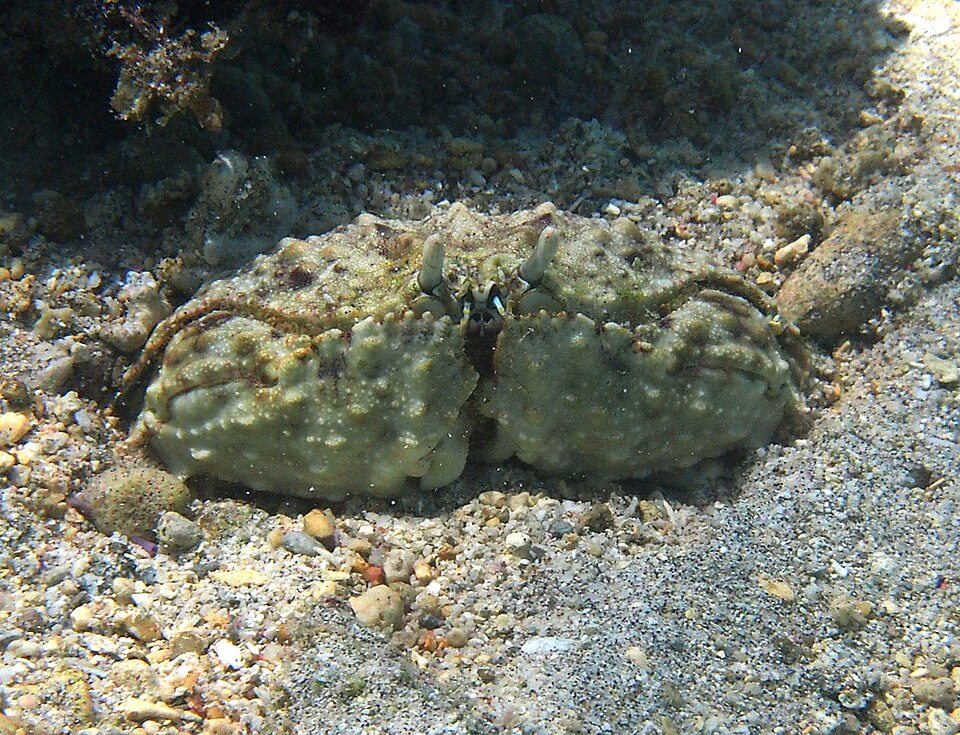
Sand suits the shy ones in the gang—what does “shy” want if not to bury itself? So the Red Sea ghost crab is happy in the sand: it buries itself with claws and legs, leaving two stalks with eyes above. It spends most of the day like that—endless outfit changes. Its claws point forward and look like hands over the face—they’re really a shield against the sand. Go ahead, stingray, yes you, hunting above—spot the invisible sand plate. Good luck.
Shy is shy, but when it comes to bivalves, the alpha comes out and pries them open like there’s no tomorrow.
Sand suits the shy ones in the gang—what does “shy” want if not to bury itself? So the Red Sea ghost crab is happy in the sand: it buries itself with claws and legs, leaving two stalks with eyes above. It spends most of the day like that—endless outfit changes. Its claws point forward and look like hands over the face—they’re really a shield against the sand. Go ahead, stingray, yes you, hunting above—spot the invisible sand plate. Good luck.
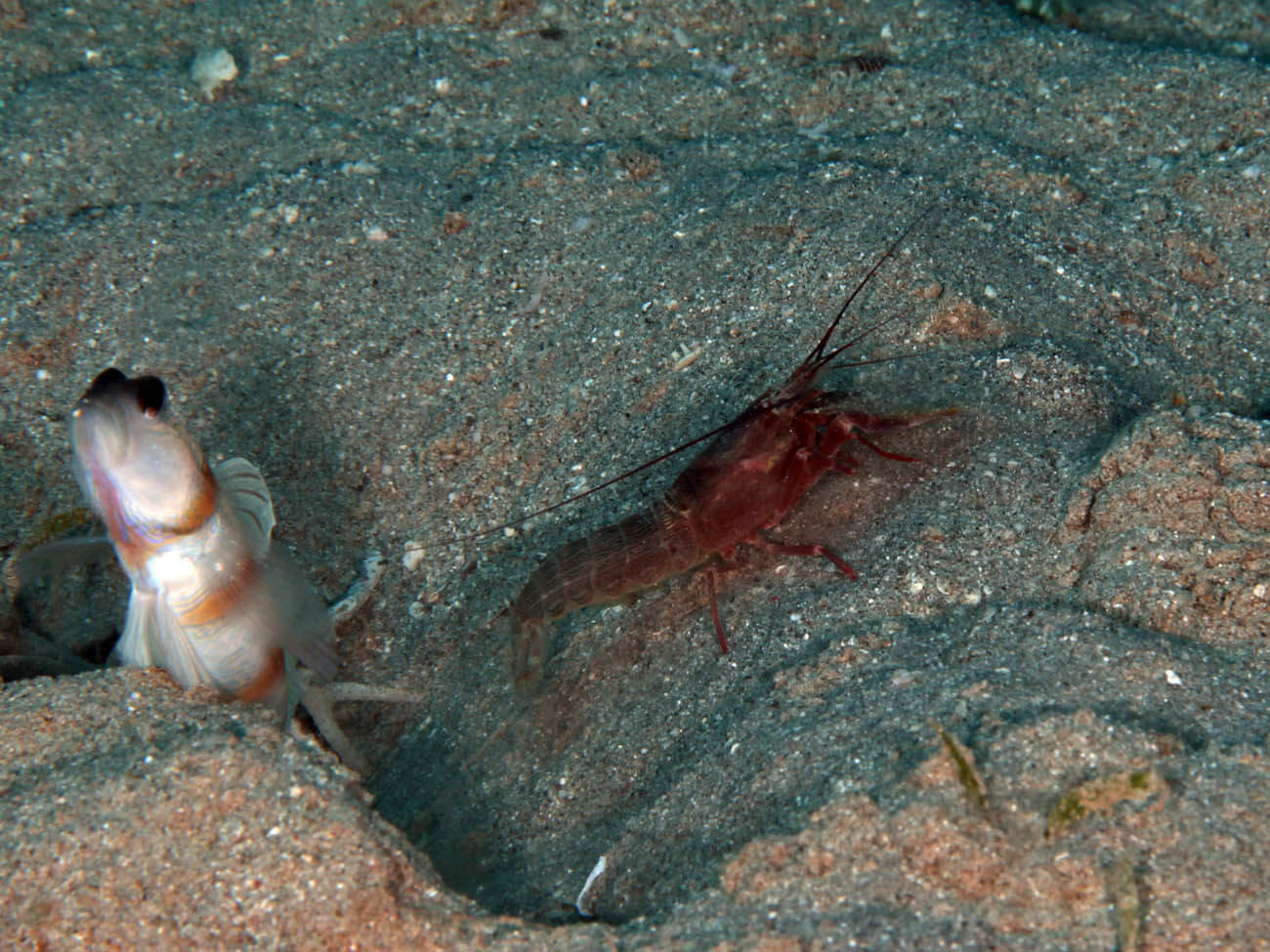
If you dig, dig like the movies. The bond between the nearly blind digger and its guide fish has been filmed plenty—it’s gone viral. Star: a snapping shrimp that digs a burrow and lives there, mostly renovating—piling sand at the mouth, going in and out to take out the “next in line.” Trouble is, it barely sees danger outside. So at the entrance it posts a bodyguard—a goby: not a contractor, but a small, loyal partner. It stands watch, never drops its guard, warns of trouble, and they stay in touch by touch. For security work the goby gets rent-free housing.
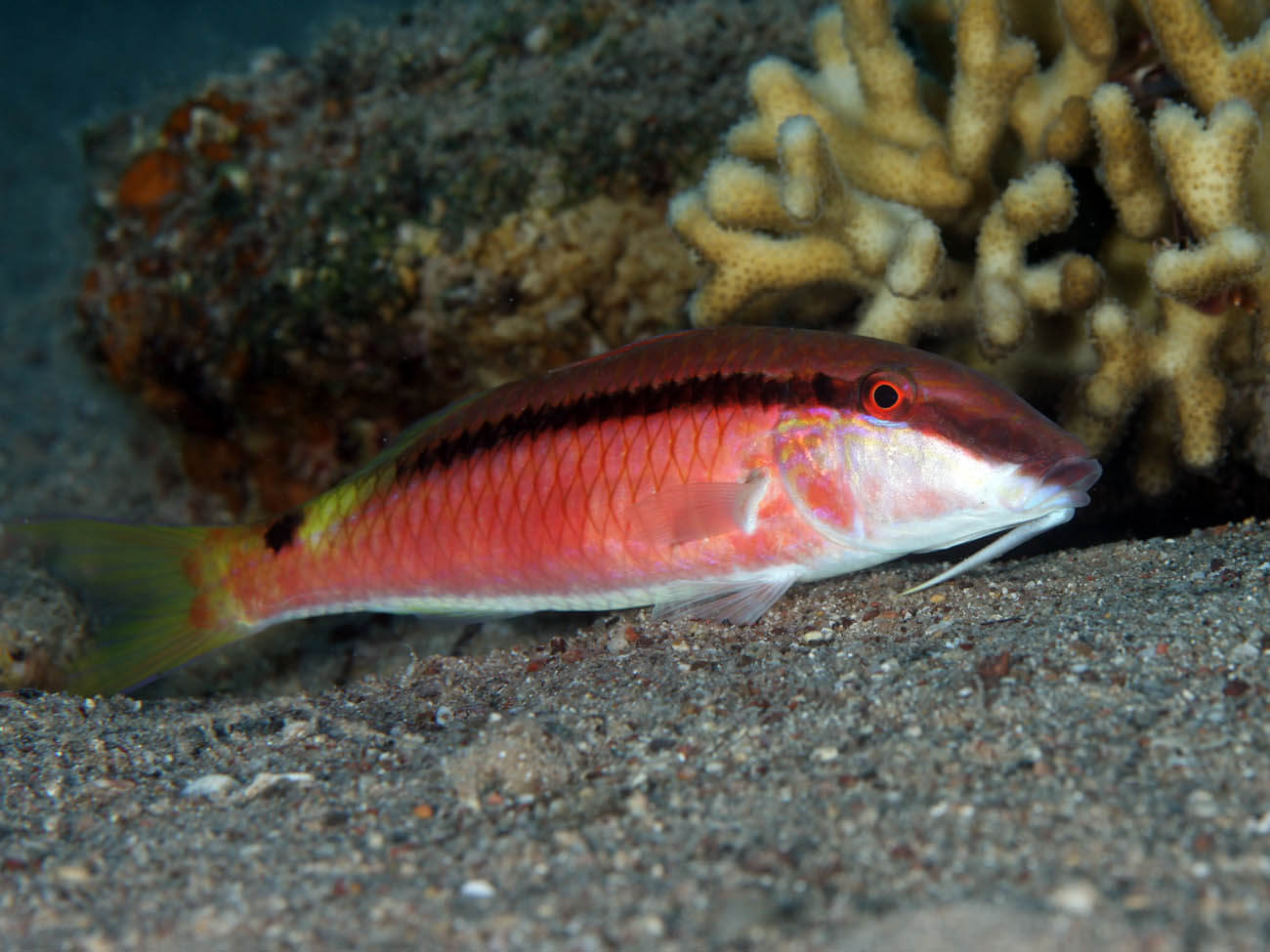
Another whose second name is digging—literally—is the sandperch: a fish with a long dark stripe and a Salvador Dalí mustache. The “mustache” is a pair of sensory barbels packed with receptors for raking and rooting on the bottom to find prey. The sand clouds it kicks up are a familiar sight on sand.
The hiders
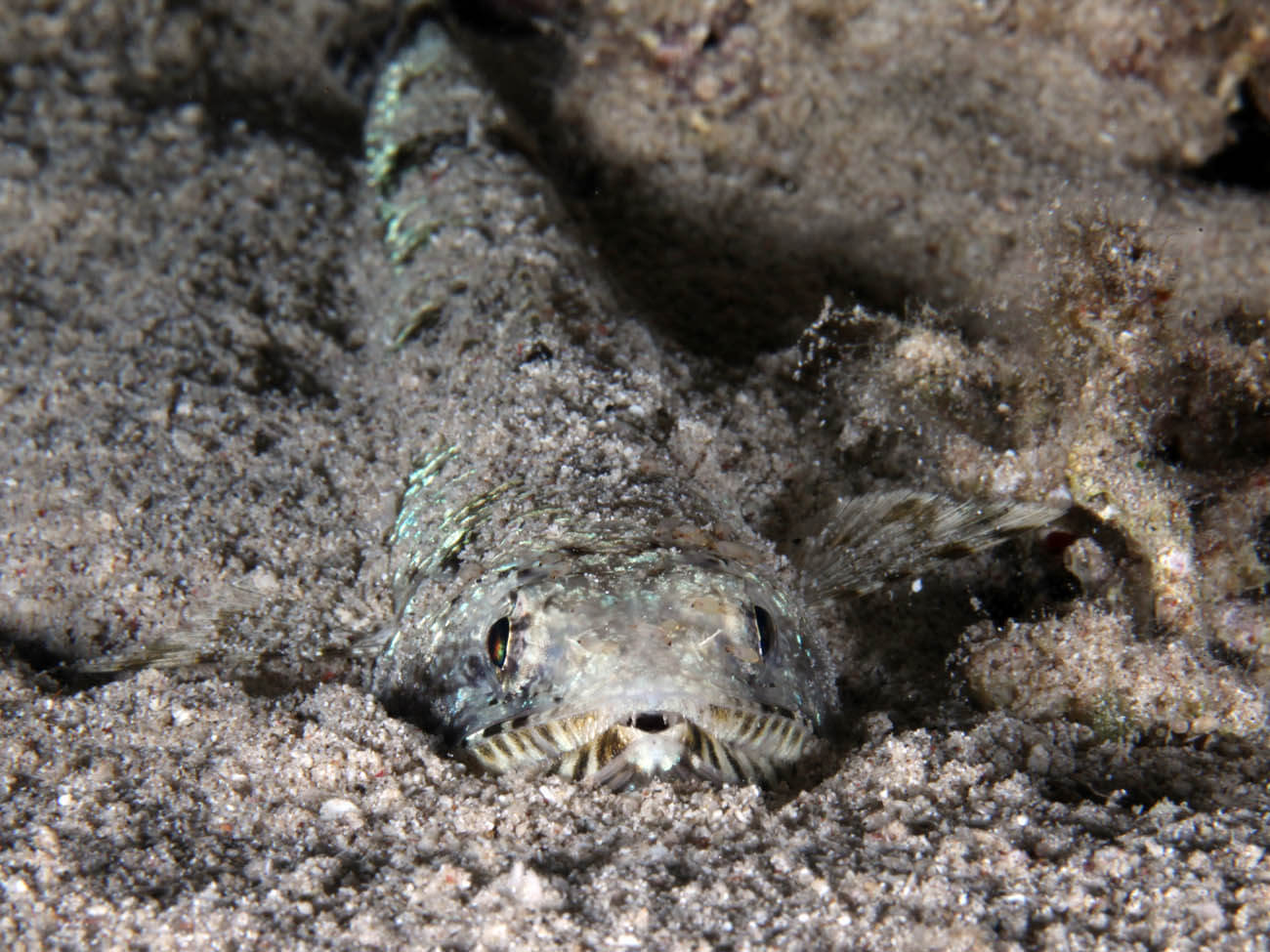
Another answer to the sandy sea desert is camouflage—color and texture that mimic sand so predators can’t spot you. One example is the leopard flounder: flat and speckled, and—with respect to teachers—both eyes really sit on its back. That lets it lie on the sand, watch its predators, and ambush prey—small fish and invertebrates.
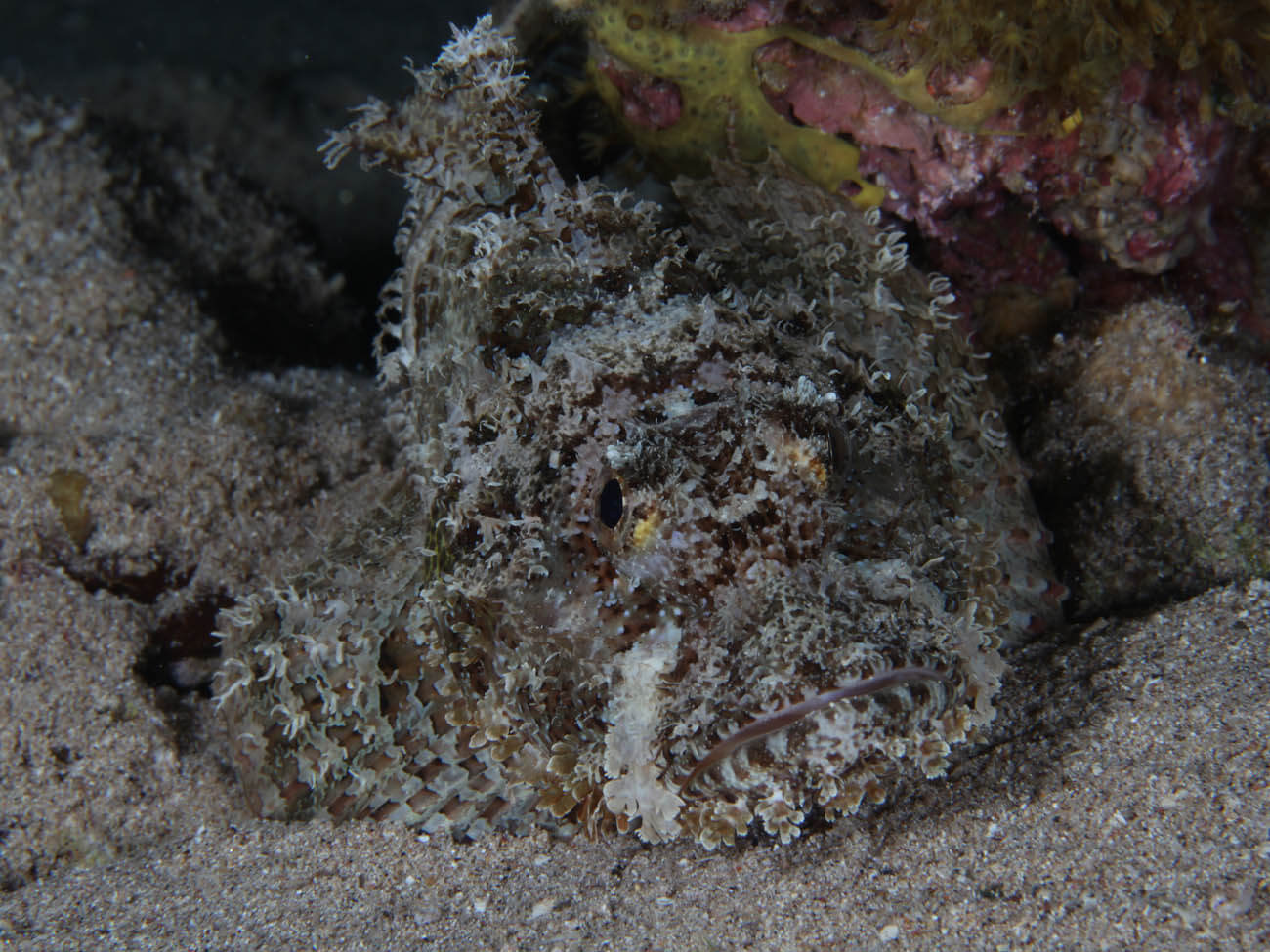
The camouflage champion is a little fish called a scorpionfish. It won’t soil its hands digging—manual labor isn’t its style—but don’t mistake it for a weakling. It has a chunky body covered in knobs and flaps that change with the substrate. Why dig when beige-on-beige with spots works—and you have superpowers: see without being seen. Prey goes by—it inhales it. Predator goes by—it has venom tucked in its fins.
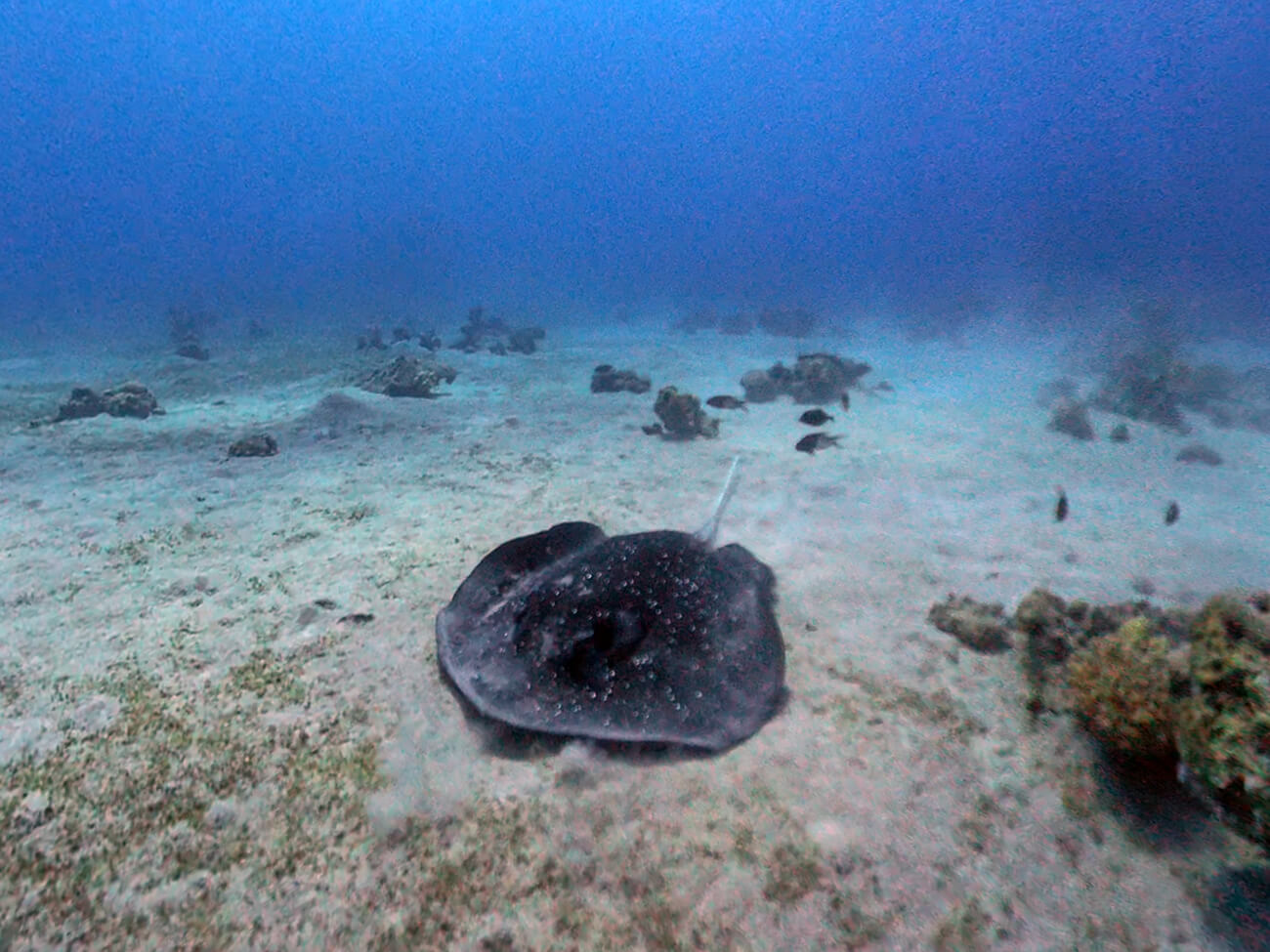
And that round, dusty “rug”? Drifted from the beach? No—it’s a mangrove stingray, half-buried, perfectly camouflaged. Round body, brown-gray with white spots, and a tail no fish or worm wants to meet—there’s a stinger inside. A big cartilaginous fish wants its daily steak—but maybe that steak is digging for its life right now. Don’t worry—that’s what electroreception is for.
Like many cartilaginous fish it has tiny sensors that pick up changes in the electric field. How does it work? Every living thing makes faint electric currents—every muscle twitch, every heartbeat. The ray and others with this sense can feel a hiding fish, leave cover, and strike.
The oxygen fixers
Sand creatures cracked the oxygen problem in all sorts of clever ways. A sea cucumber called the “black cylinder”—looking like a cucumber in the sea or a black roll—is a classic water pump. It pulls water in, takes the oxygen, then flushes it out. While oxygenating itself it also feeds—its arms work like rakes, gathering nutrients. What’s left comes out as neat cylinders of clean sand. If you see one on the bottom you might not picture a sweaty farmer—but it’s one of the sea’s tractors. Its plowing matters for ecology the way plowing matters on land: moving sand aerates the bottom, brings in oxygen, keeps the system healthy.
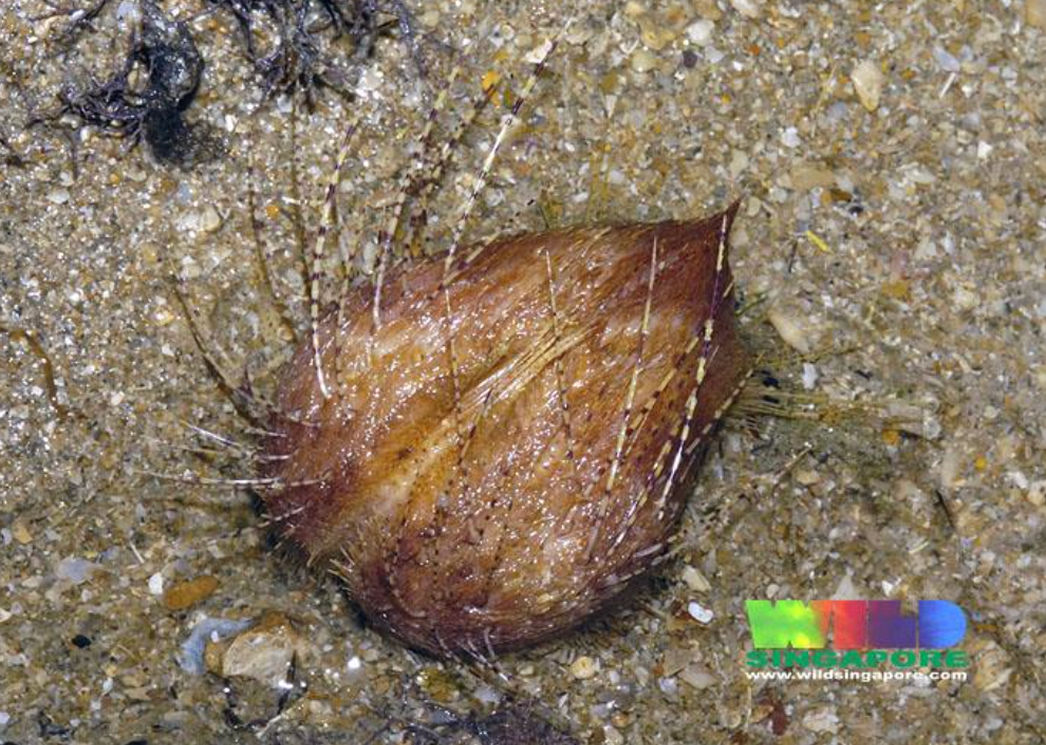
The long-spined urchin doesn’t just cope with low oxygen—it engineered a portable underground ventilation system. Meet it: a common Gulf of Eilat urchin, like all urchins spiny all over. Shaggy look, awkward bald patch with spines—take our word, you don’t want those spines through your foot. As a pro burrower that can vanish in a minute, it needs oxygen down there. What does it do? It digs a vertical shaft—like a thick straw water is drawn through. Because it moves fast in sand, it’s already building the next straw while the old one drains water out. Like many sand creatures it pumps water and filters food—lots of sand goes through the gut, organic food is sieved out.
Go ahead—rest your head on the dune
The residents of the marine sandbox aren’t here only to sunbathe on a dune and play backgammon. The long-spined urchin, the sea cucumber, the ghost crab, and all the other diggers, burrowers, and sand-stirrers do a wonderful service for the seabed: they plow and aerate the system, with bacteria and animals breaking down, mixing, and moving organic matter. Sand isn’t just sand—it’s a whole recycling industry feeding every creature in the sea, including the coral reefs you ogle through your mask.
Even though soft bottoms are the second-largest ecosystem on Earth, and even though marine life depends on them, they don’t get the public or scientific attention their “siblings” do. The sandy bottom is threatened by coastal development and infrastructure, pollution and ship spills, waste and plastic washing in as if by right, oil risk overhead, sand mining, and other mostly human activities. We have to protect the sand.
The dwellers of the marine sandbox aren’t here only to lay their heads on a dune and play backgammon. Every digger, burrower, and sand-churner does a wonderful ecological service for the seafloor: they till and aerate the system, together with bacteria and animals that break down, blend, and move organic matter. Sand isn’t merely sand—it’s an entire recycling industry that nourishes every creature in the sea.
For further reading

Features of the sandy habitat in the Gulf of Eilat (Jordanian coast)
The symbiosis between snapping shrimp and goby
National Monitoring Program reports — Interuniversity Institute
Next stop
The Open Sea
Discover the open spaces of the sea, home to migratory species and dynamic marine life